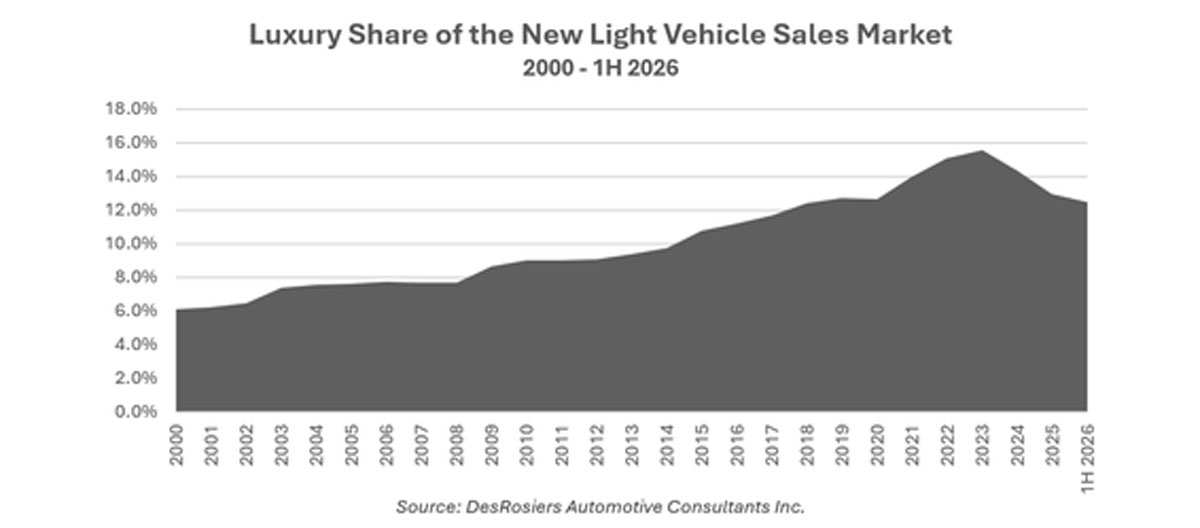
Canada’s luxury vehicle market has given back years of growth, with its share of new light vehicle sales falling to 12.5 per cent in the first half of 2026, according to new analysis from DesRosiers Automotive Consultants (DAC).
The decline follows a peak market share of 15.6 per cent in 2023 before easing to 14.4 per cent in 2024 and 13.0 per cent in 2025. DAC said luxury vehicles now account for roughly the same share of the market as they did in 2018.
The firm attributes the shift to a combination of economic and policy factors, including higher vehicle and insurance costs, Canada’s counter-tariffs on imported vehicles, evolving zero-emission vehicle mandates, Tesla’s fluctuating sales, slower real estate activity, weaker population growth and broader economic uncertainty tied to ongoing Canada-U.S. trade tensions.
DAC also points to the federal luxury tax as a growing concern for retailers. Introduced in September 2022, the tax applies to new vehicles priced above $100,000. The federal government recently confirmed it will eliminate the luxury tax on private aircraft and yachts, but the levy will remain in place for passenger vehicles.
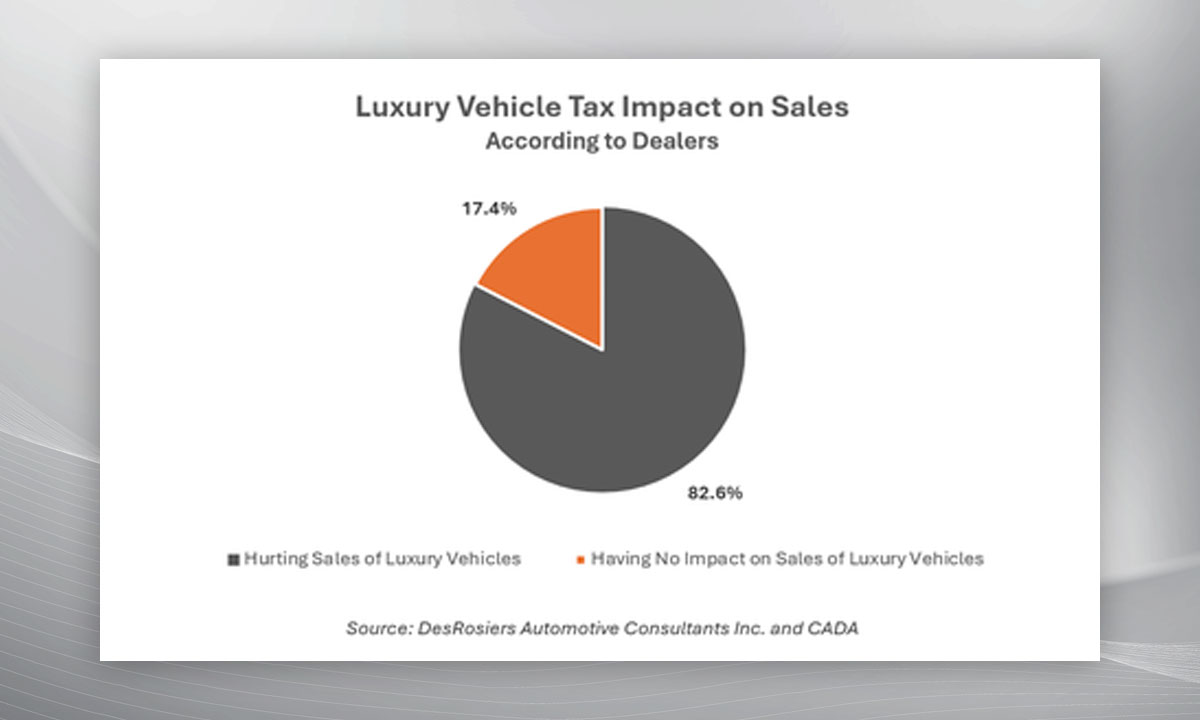
To gauge its impact, DAC partnered with the Canadian Automobile Dealers Association (CADA) on a survey of new vehicle dealers. According to the survey, 82.6 per cent of respondents said they believe the luxury tax has hurt luxury vehicle sales in Canada.
“Whether the luxury market has come to the end of its 25 years of ongoing growth remains to be seen,” said Andrew King, Managing Partner at DAC. “However, what is clear is that the luxury tax — with its $100K threshold not even being inflation adjusted since 2022 — is an increasingly negative factor in the market.”