Photo credit: Perry Lefko
In what he called a “great day,” Prime Minister Mark Carney unveiled a robust, multi-faceted plan to protect the Canadian automotive manufacturing industry, spur sales of electric vehicles (EVs) and maintain a platform of clean energy.
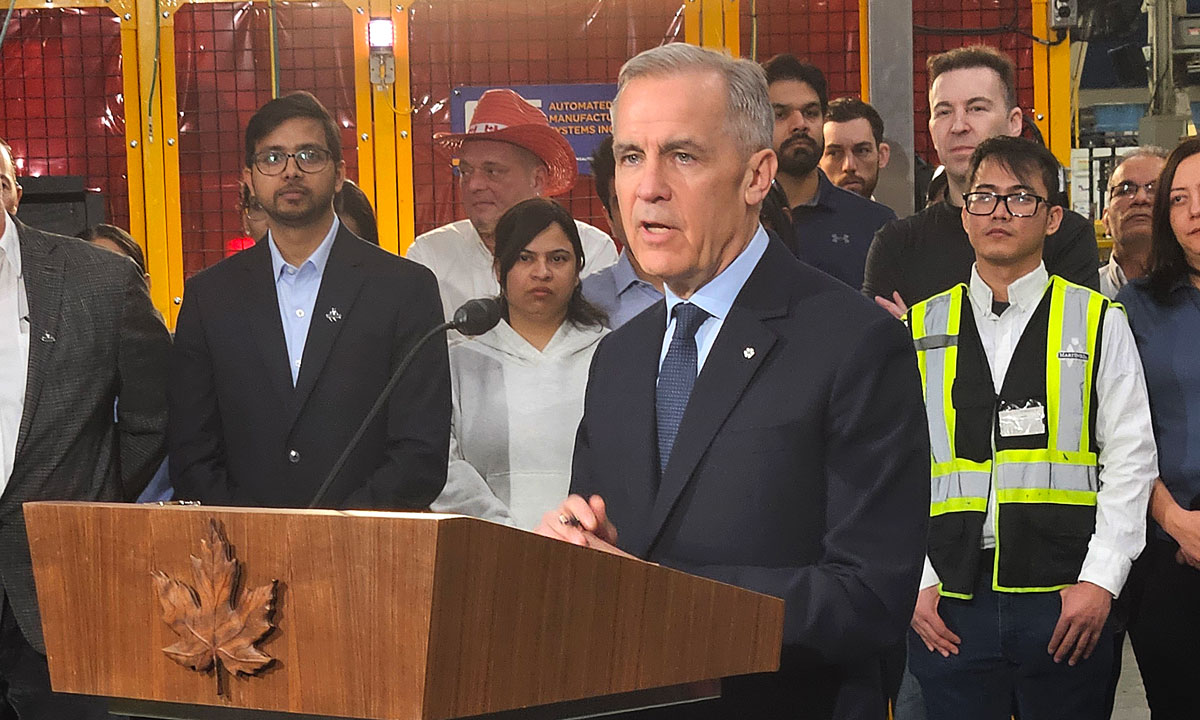
Canadian auto dealer was on site Thursday for the announcement at the Martinrea International auto manufacturing facility in Vaughan, Ontario (Woodbridge area). Surrounded by company employees and industry executives, Carney announced a series of investments that he said will shape the future of mobility and advance manufacturing in Canada to build a stronger, more competitive and more independent country.
He revealed several financial incentives for manufacturers for both the present and the future, a new framework to replace the previous government’s Electric Vehicle Accessibility Standard (EV sales mandate), a restoration of rebates for buying EVs, with no cap for Canadian-made EVs, and a continued commitment to clean energy, albeit with revised targets.
Carney’s plan has five pillars:
- Accelerating investment in Canadian auto manufacturing.
- Rationalizing emission-reduction policies to focus on the outcomes that matter to Canadians.
- Strengthening domestic demand and making EVs more affordable and reliable for Canadians.
- Establishing a comprehensive trade regime to strengthen the competitiveness of Canada’s auto sector.
- Protecting Canadian auto workers facing immediate pressures while helping them bridge to the future.
He further stated his government is accelerating investment across the auto value chain to support strategic investments by Canadian companies.
He said $3 billion will be dedicated from the Strategic Response Fund and $100 million for the Regional Tariff Response Initiative.
“This is capital that will help our businesses respond to those trade disruptions, help them pivot their operations, retool plants to increase productivity and invest in advanced manufacturing and expand into new markets,” said Carney. “In line with our Buy Canadian policy, the Government will leverage these investments to maximize opportunities for Canadian suppliers and Canadian-made goods and services, including in steel and aluminum.”
He also said his government is implementing the “most comprehensive investment incentives” for the auto value chain “anywhere in the world.”
He said the new Productivity Super-Deduction unveiled in the 2025 budget will reduce Canada’s marginal effective tax rate on investment to about 13 per cent (13.2 per cent), positioning Canada below the United States on key manufacturing investment measures.
He said businesses can immediately expense 100 per cent of their investments in manufacturing machinery, equipment, buildings, zero-emission vehicles and scientific research and development.
He also said his government will implement the Clean Electricity Investment Tax Credit and expand the Clean Technology Manufacturing Investment Tax Credit.
He said the tax rate for zero-emission technology manufacturers is being reduced so they benefit from half of the normal corporate tax rate.
“Quite simply we’re making Canada the best place to invest, the best place to build, the best place to build clean.”
He said Canada will set a new and more ambitious sovereign path to reduce automobile emissions. He said that will be done by strengthening Canada’s vehicle greenhouse gas standards by 2035, achieving the equivalent emissions reductions of a 75 per cent EV sales rate.
By leveraging new investment in EV production, consumer incentives and charging infrastructure, the plan is to work toward achieving a 90 per cent EV sales rate by 2040.
He said the auto sector will transform into becoming “our own best customer.”
He also announced a $2.3-billion EV rebate plan over the next five years, replacing the old program that ran out of funding.
Canadians who purchase or lease a battery-electric or fuel-cell EV will receive a rebate of up to $5,000 for a vehicle with a final transaction value of $50,000 or less and up to $2,500 for plug-in hybrids.
To support the Canadian auto industry, Carney said the $50,000 cap will not apply to Canadian-made EVs or Canadian-made hybrids.
“Those incentives will only apply to vehicles produced in countries with which Canada has free trade agreements,” said Carney.
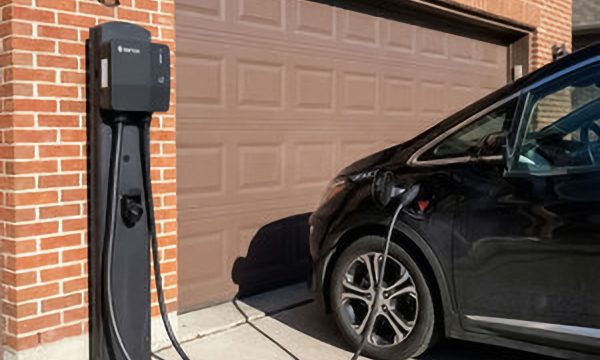
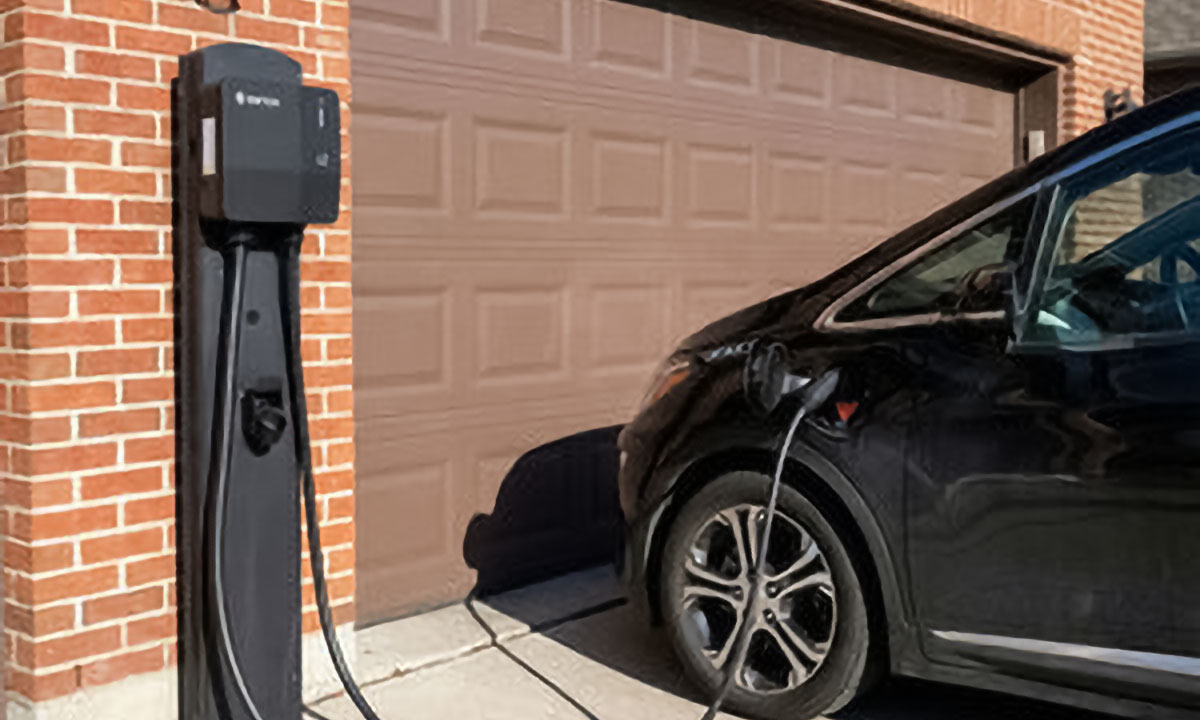
He also said the government will make it easier and more convenient for Canadians to charge their EVs because of concerns about reliable charging access, especially in rural and northern communities.
He said the government is developing a new national charging infrastructure strategy, including $1.5 billion in investments through the Canada Infrastructure Bank.
“So wherever you live in Canada, charging your vehicle should become as simple as filling your gas tank,” said Carney.
With the Canadian flag behind him and the banner Building Canada Strong off to his left, Carney addressed the shifts his government believes are necessary amid U.S. tariffs and global changes in auto manufacturing.
“This is a pivotal moment both for the industry and our economy,” said Carney. “We know that U.S. tariffs have upended the bargain that’s existed for as long as I’ve lived. It puts our workers, our businesses and our country under a cloud of uncertainty. That trade relationship that was once a great strength has now become a serious vulnerability. But I want to be clear that Canada still has the best deal of any U.S. trading partner.
“We also know that the global auto sector is being radically transformed — rapid shifts toward lower emissions, greater connectivity and even more advanced manufacturing. So the decisions Canada makes now will shape careers, communities and our economy for decades to come — and we will not miss this opportunity. A confident Canada is making the strategic decisions and the generational investments today to build the affordable, enjoyable and lower-emission automobiles of the future. Canada is an auto nation. The auto industry is central to our story … a pillar of the Canadian economy.”
He said the objective of the Canadian government is to see tariffs removed in the auto sector over time and to build the strongest North American auto sector, while maintaining measures to protect Canadian industry in the interim.
In the coming weeks, he said, his government will introduce a new electricity strategy to double the country’s grid capacity, modernize infrastructure and deliver electricity that is more reliable, more efficient and more affordable. He said this will enable Canadians to adopt low-carbon technologies such as electric vehicles while supporting the electrification and growth of Canadian industries.
Minister of Industry and Trade Melanie Joly emphasized Canada’s strength as an auto nation.
“We have the best auto workers in the world and we will build the best cars in the world for the world,” said Joly. “We will invest in those who invest in us.”

Photo credit: Perry Lefko