Interest in electric vehicles is on the rise in the United States and China despite the COVID-19 pandemic, according to a new 2020 Global Mobility Navigator Study by Ipsos.
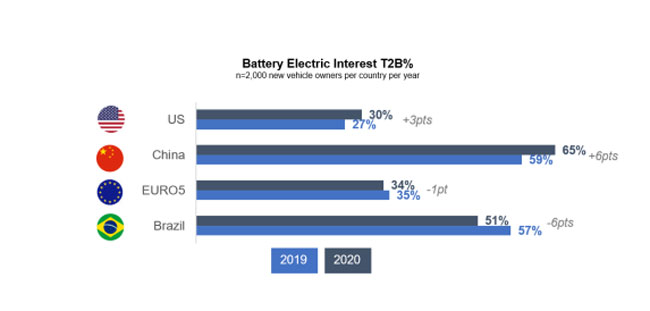
The study focuses on electrification and indicates that global interest in this field is on par with 2019 figures — with an increase in the U.S. (30% in 2020 versus 27% in 2019) and Chinese (65% in 2020 versus 59% in 2019) markets. The increase can be attributed to a boost in consumer familiarity with battery electric vehicles (BEVs).
“In the U.S., knowing a fair amount about BEVs more than doubles consideration for them. Increasing future sales for BEVs will rely on companies improving awareness of their product,” said John Kiser, Senior VP, U.S. Automotive & Mobility, Ipsos.
He adds that the auto industry has seen the need to improve familiarity with products in the past, such as some advanced driver-assist features like ACC and autonomous driving. According to Kiser, the increase in consumer awareness “is what led to an increased desire to have them in vehicles.”
In comparison to the U.S. and Chinese markets, the EURO5 saw a decrease of one point this year, from 35% in 2019. And Brazil was down six points in 2020, from 57% last year.
As for the key drivers around why consumers are selecting BEVs, Ipsos said
convenience was a top priority (access to public transport and express lanes), followed by style — how nice the vehicle looks and fits the consumer’s taste. The last key driver is a BEV that features more advanced technology.
“By establishing the winning formula as greater knowledge equals greater consumer interest, electric vehicle manufacturers must focus their marketing on increasing familiarity with BEVs,” said Ipsos. “A critical component for messaging is tackling the key barriers preventing drivers from adopting a BEV.”
The study also revealed what the top five issues that OEMs will need to address are: driving range, affordability, access to charging stations, overall ownership cost, and battery life.
OEMs and dealers will need to stress to consumers that many BEVs on the market do have substantial driving range and are affordable when considering the money saved on gasoline. Furthermore, it is important to help consumers understand there is also easy access to charging with home Level-2 chargers on the market.
To help consumers overcome their fear of the BEV unknowns, Ipsos said they need to be educated on the product so they can feel comfortable and confident with their choice. “Companies should focus on what truly matters to potential buyers and present that information in a consumer-friendly manner,” said Ipsos.
This means things like: how many miles per charge do you get from the vehicle, how quickly can it charge, how many charge stations are there in my city, and how much would the average driver save on gas in one year?
“This is all relevant information consumers want to know upfront, before considering getting behind the wheel of their very own BEV,” said Ipsos.
View the full study here.