25,000 descend on Toronto for massive tech conference that touched on auto industry trends.

When you say “collision” to car dealers, it means something completely different.
But the type of collision that crashed into Toronto and turned the city upside down from May 20-23 was a welcome event. Billed as North America’s fastest-growing technology conference, the event brought more than 25,000 delegates to Toronto from 125 countries to hear from more than 730 speakers, and was covered by more than 900 journalists.
The “collision” was one of ideas, as technologies and trends from various industries are indeed colliding and overlapping and having a profound impact on society, business, transportation and media.
Federal, provincial and local politicians — including Prime Minister Justin Trudeau, Ontario Premier Doug Ford, and Toronto Mayor John Tory — were on hand to welcome attendees and thank them for bringing the event to Toronto, where it will be held for at least another two years.
The energy and buzz generated by the event was incredible and it featured 1,100 startup companies who were pitching their businesses to anyone who would listen, hoping to catch the interest from the more than 800 investors in attendance. Organizers say the event has become a crossroads for the world’s largest buyers and sellers of technology, alongside many of the world’s most disruptive emerging tech companies.
For the auto industry, there were a lot of discussions and sessions about future mobility trends, shared vehicle ownership, and autonomous vehicles.
It’s impossible to do an event of this scale justice in one article, but here are a few highlights from some of the sessions we attended.
For the auto industry, there were a lot of discussions and sessions about future mobility trends, shared vehicle ownership, and autonomous vehicles.
Dmitri Dolgov, the Chief Technical Officer with Waymo, told attendees that progress continues to be made in testing their fleet of autonomous vehicles.
The company has run ten million miles of testing on roadways in Phoenix, Ariz. and continues to develop their technology. “Ultimately we believe self-driving vehicles can transform transportation more broadly,” said Dolgov.
He said ride hailing autonomous vehicles are just the beginning. He anticipates Waymo to move goods, trucking, move people to transit locations and drive people in their own vehicles.
Their systems are all built in house, and they are using the power of artificial intelligence and deep learning to constantly improve software and hardware. “AI has been a game changer,” said Dolgov. “We began to apply deep learning to our own systems.”
There were a lot of sessions about artificial intelligence and machine learning, and how the technology will impact our lives, our jobs, and society.
David Eun, Chief Innovation Officer & President of Samsung NEXT, Samsung Electronics, said his company will invest $22 billion in the next three years in AI and 5G. The company sells five million displays a year, and they want every display to have some form of intelligence in them.
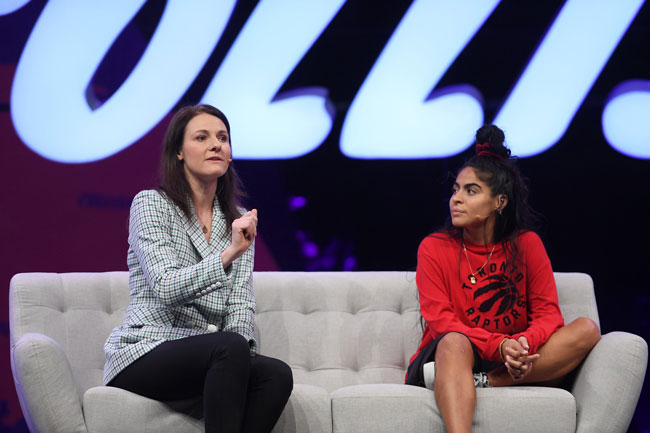
Eun said his company is also assessing the impact of broader consumer trends, like the fact that younger people tend to prefer “experiences over things.” This has profound implications for companies that “make things” — including vehicle manufacturers. If the next generation of consumers don’t value owning things the same way that previous generations did, what does that mean? “They want authentic social experiences rather than purchasing transactional items. The things are a means to a greater end,” said Eun.
People prefer “instagrammable” moments, because they are inherently social and more compelling. “When you have these memories, and experiences, they are more apt to have positive experiences. It’s linked to people’s happiness.”
He said a company in Germany is converting almost anything you might buy into a subscription service.
There was also a lot of talk about “data” and what to do with it. Rebecca Kaden, General Partner, Union Square Ventures, said industry’s interest in data has evolved from phase 1, when nobody really cared about data, to the second phase, figuring out how to collect it, then figuring out how to sell it. Now, the fourth phase is figuring out how to use it strategically, which she says is the most important value data can bring.
Kaden said that despite the data hype, the time where simply having vast amounts of data was considered an equity asset for a company has passed. “We are looking past that. What pieces are the most relevant to improve the product you are making yourself? It’s not just gathering data that can be sold to someone else. Be thoughtful about the data you collect,” said Kaden.
“People are finding they can rent out their car a few days a month and recover some of the costs of car ownership,” — Andre Haddad, CEO of Turo
In a session looking at the future of car ownership, clean mobility and autonomous technology, investors and technology companies took the stage for a lively discussion.
Daniel Kirchert, CEO, Byton, an electric vehicle startup, said autonomous tech and the sharing economy are coming, as the car becomes a highly-connected device with giant touchscreens, and facial recognition. “We believe the car will become a digital living space,” said Kirchert. “It will be important about how we spend time in the car.”
In terms of car ownership trends, a topic of great interest to car dealers, Andre Haddad, CEO of Turo, said people will still own cars, but will own fewer of them. “People are finding they can rent out their car a few days a month and recover some of the costs of car ownership,” said Haddad.
He said his company, which manages a car sharing marketplace, tracks vehicle ownership in its community and it’s been dropping by 10 points every year. “Car ownership could reach 70 per cent of the population instead of the 90 per cent today,” said Haddad.
For anyone interested in attending next year’s event, visit: https://collisionconf.com