
Chrystia Freeland, Canada’s Minister of Foreign Affairs, and the person at the centre of the tense negotiations with the U.S. over a renegotiated NAFTA agreement, talks with Canadian auto dealer editor Todd Phillips about trade, Trump and Trudeau and sheds light on what we can now expect with the new USMCA trade agreement.
(You can also find this exclusive interview and read our full report on USMCA, including exclusive video interviews and behind the scenes commentary in a special page devoted to our USMCA coverage)
Canadian auto dealer: We want talk about where we go next with USMCA, and what our industry can expect, but first, we want to revisit the story of what almost happened. We talked to a lot of auto industry leaders who feared our industry was headed for “Car-mageddon.” What did it look like from your perspective?
Chrystia Freeland: Well we were very aware of the importance of trade with the United States for Canada, for the Canadian economy, for so many working Canadians and Canadian families. We were very aware that the car sector would probably be the engine of the agreement, or at the heart of the agreement, and that’s absolutely true. The integrated North American car sector, but most specifically, the integrated Canada-U.S. car sector, predates NAFTA with the Canada-U.S. Auto Pact. We also knew what we were up against. This U.S. administration, I would say, is the most protectionist administration that Canada has worked with since the 1930s. It’s an administration which is proudly and openly protectionist. The Trump administration did, in the course of the negotiations, impose 232 tariffs on steel and aluminum and was very openly talking about the possibility of 232 tariffs on cars and car parts. So we were very, very aware of the importance of getting a deal. At the same time we were extremely aware of the fact that you have to negotiate from a position of strength, and when the Prime Minister and I said repeatedly, “we want a good deal, not just any deal,” that was absolutely sincere. I think ultimately what made a deal possible was the fact that at the end of the day, the Americans believed us.
I think of particular relevance to the car sector is a part of the negotiations that happened long before the final days and weeks. The starting position of the U.S. renegotiations was to call for 50 per cent U.S. domestic content in cars to qualify for NAFTA preferences, and we knew that would decimate the Canadian car sector. It was absolutely unacceptable, and it was a total red line for us — that was something that would not be possible for Canada. The first month of the negotiations were really dominated by a real clash over that issue. In January, Canada put forward some creative ideas on the rules of origins for cars. We made an effort to think about what was the U.S. was really trying to achieve, and whether there were some ways the U.S. could achieve it without hurting us. Initially those ideas were rejected quite forcefully, but ultimately they laid the groundwork for a very good conversation that we had in March where we came to a high level agreement on principles with the U.S. on what the new rules of origin in the car sector would look like.
CAD: That’s when the foundation was laid for what came next?
Freeland: In March the U.S. withdrew their idea of a 50 per cent U.S. domestic content requirement for cars and that really made it possible for us to do a deal. Instead, the idea that collectively we came up with was this labour value content requirement.
CAD: On a more personal note, for 14 months you were in this pressure cooker with the fate of NAFTA in your hands. What was that like? I’m sure it was no picnic.
Freeland: Well I am able to be a better mother, wife, and daughter than I was at that time! It got to the point where my kids became pretty expert in rules of origin and my nine year old, when he asked me for things, started to say “okay we’ve negotiated the first chapter mom, now let’s go on to the second one.” I would say I felt a very serious sense of responsibility. I was really absolutely struck by, and I think this was kind of Canada’s secret sauce in the negotiations, the extent to which we really played as team Canada.
I had a meeting today with the car parts sector, and one of the people who was at the meeting said that from her perspective it was an unprecedented level of collaboration between government and industry. I really experienced a tremendous collaboration with, frankly, the whole country, business, unions, provinces, cities, territories, selected officials from all parties. I felt we were all really engaged and really on the same team and that was unique to Canada in this negotiation. There were a lot of structural disadvantages that we had in the negotiations, but the really strong advantage we had is our whole country really played as a team and really was united. That was actually very inspiring to me, I felt really proud of Canada and of Canadians.
The other thing that I really experienced in the negotiations was huge respect for Canada’s trade negotiators. They are truly the best trade negotiators in the world. One of them said to me “We’re like the Navy SEALs of Canada.” I really do feel that way about them.
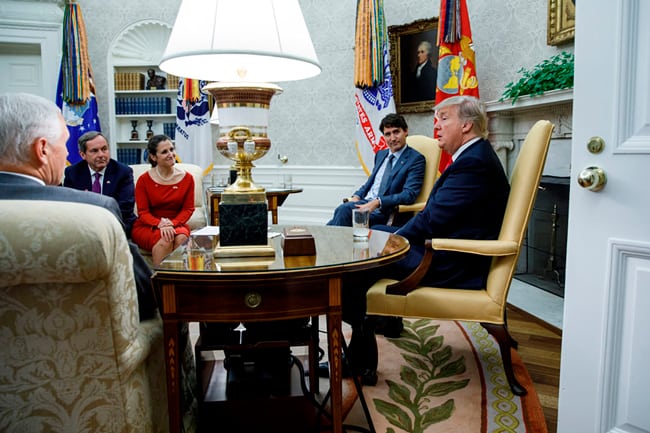
CAD: When we interviewed auto industry leaders for our special report on USMCA, something that was fairly unanimous was that they were impressed with the negotiating team, that Canada never blinked, and stood up to a very formidable adversary. President Trump is not the easiest guy to be dealing with. How did you, and your negotiating team, keep your cool dealing with a fairly mercurial adversary who could go off at any moment? How did that play out?
Freeland: In terms of how we negotiated with the U.S., when it comes to the President, his counterpart was, and continues to be, the Prime Minister. I obviously am biased, but I had a very inside view of that relationship and I continue to. I would like to share with your readers the fact that the Prime Minister has done and continues to do an outstanding job. He really is a statesman, he has a true gift for dealing with people, all kinds of people, and I think he is doing that very important job remarkably well.
For me, my counterpart was Ambassador [Robert] Lighthizer, the U.S. Trade Representative. We certainly had some tough exchanges, but I respect him very much as a professional and I hope that he would feel this way too. We developed a really cordial relationship after it was all done. He came to my house for a roast beef dinner with me and my family. He’s a tough negotiator, but I hope that he would think the same thing about me.
CAD: But it got very personal at one point. President Trump said something like “we’re unhappy with the negotiations and we don’t like their representative very much.” That seemed to have been singling you out. But you didn’t take the bait like so many other people do. A lot of others get drawn in and it just gets worse. The industry was obviously watching very carefully, and didn’t want to see us get drawn into this crossfire.
Freeland: You know in my mind I have always been clear about a couple of things. You know, I’m always very clear that I am paid in Canadian dollars and my job is to stand up for Canada and Canadians and get the best possible deal for Canada and Canadians. Ultimately the only people whose good opinion matters to me are Canadian, so you know, that was the attitude I had really throughout, and it’s the attitude I have now.
CAD: The auto industry was actively lobbying and communicating its positions to the government during this process. Did you feel they were speaking with one voice?
Freeland: I wouldn’t even call it lobbying. I made a point personally of meeting very often with industry representatives, often calling individual people up and asking their point of view. Particularly in moments when things needed to be decided, and people were really good, we all had each others cell numbers, and people were very good about making themselves available when I needed to talk to them, including in the last weekend. When people got information they would always share it with me, so we were really very closely and constantly in touch, both through official meetings but also more informally. We worked very closely with industry and also with unions. I would say more to your point about was industry united, I do think the industry did a very good job of devoting the time necessary to work on this and devoting the time to work with the negotiators, to work with me, and a really good job of presenting a united front and playing for team Canada. There wasn’t infighting, and that was really important.
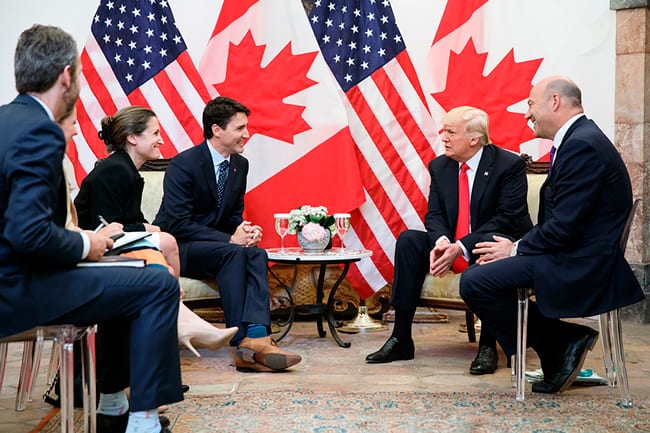
CAD: I just want to jump into looking ahead now. You have called the tariffs on steel aluminum “unjustified, illegal, absurd.” What is Canada doing now to fight to get them lifted?
Freeland: I did say that yesterday in Niagara, and I’m happy to say it again, that’s been the Canadian position since the tariffs were first being introduced. The idea that Canadian steel and aluminum could pose a national security threat to the United States really is illegal, it is unjustified, and it is frankly absurd. It’s worth remembering, that on top of all of that, our trade in steel with the U.S. is balanced and mutually beneficial. In fact, the U.S. has a slight surplus with us, so the U.S. tariffs are really just the wrong thing to do. Canada’s response was strong and immediate, as soon as the U.S. announced the imposition of the tariffs, our government announced retaliatory measures. Our response was measured, it was perfectly reciprocal, a dollar for dollar retaliation. We built in a 30 day cooling off period, but when we didn’t get any action, then we imposed that retaliation.
I was very confident then that was the right thing to do, and I continue to be really confident it was the right thing to do, partly because we are now really seeing the combination of the U.S. tariffs, which are harmful to the U.S. All of those buyers of Canadian steel and aluminum now have to pay 25 or 10 per cent, and when you add on top of that our retaliation, this is really having some meaningful negative consequences in the United States and people are speaking up over the past couple of days. The ITC has been holding hearings on NAFTA in the U.S. and the U.S. stakeholders speaking in their hearings have been saying we are prepared to support the new NAFTA, but the steel and aluminum tariffs have got to go. So that’s really what needs to happen and as far as Canada is concerned this is a very easy problem to solve. If the U.S. wants to lift its tariffs on our steel and aluminum, we’re happy to lift our retaliation this afternoon.
CAD: Do you think they might be lifted prior to the signing of the USMCA deal, and do you know when the timing of that looks like?
Freeland: You know one thing that I learned in the course of this negotiation, is that it’s a very bad idea to try to make predictions about U.S. politics.
CAD: I’ll give you that one. Do you know when Canada might ratify the agreement? Do you anticipate any issues getting it through Parliament?
Freeland: Well there’s a process that needs to be gone through, and the first step is for the agreement to be signed and then there’s the ratification process. We will be going through that process. I think that it’s going to be important to have a debate in Parliament about it and we’ll need to go through all of those steps. I do feel confident that it will be ratified in Canada in due course. This is a good deal for Canada, and I’m confident that the House and the Senate will come to that conclusion too.
CAD: I know predicting U.S. politics is tricky, but there’s a new U.S. Congress, there’s been some rumblings already that a Democratic controlled Congress might be looking at the agreement. Do you have any concerns in that regard?
Freeland: When it comes to the U.S. political process, I think it’s really important for us to respect that process and to respect the sovereignty of the United States. We have our own political process, I don’t think any Canadians would appreciate it if the United States started to get involved in our domestic ratification and I think the same approach is appropriate when it comes to their domestic ratification process.
CAD: We interviewed former Prime Minister Brian Mulroney at the CADA Summit for auto dealers last year. He was an advisor to your government during these talks. He told a story about how reaching the original NAFTA agreement came down to his personal relationship with President Ronald Reagan. You must have witnessed that yourself, that at the end of the day it’s about people reaching an agreement.
Freeland: The Prime Minister’s personal role was absolutely essential, and his relationship with the President. The way he handled that was absolutely key to the outcome that we achieved, and so was the way that he handled the negotiations.