 Last week’s federal budget came and went without any earth shattering news. It was the first budget delivered under the majority rule for Prime Minister Harper’s Conservatives. The Canadian Automobile Dealers Association released a budget analysis that sheds light on the details of the budget.
CADA’s analysis sent to its member dealers describes the $5.2 billion in ongoing departmental spending reductions as “modest” based on the government’s annual $270 billion budget expenditures. “The cuts are on the modest side of things, particularly compared to what other countries have had to endure in recent budget cycles,” says the CADA release.
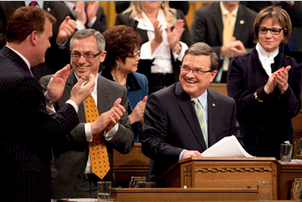
CADA President and CEO Rick Gauthier was even quoted in the main budget document, a move that CADA says helps demonstrate the association’s growing policy influence. “This rare association achievement reflects the positive and ongoing working relationship between CADA and the Minister of Finance,” says the CADA release.
An excerpt from the actual budget documents is below:
“Canada has emerged from the recession of 2008-2009 as a leader in the pack of industrialized nations. And while it is important not to rest on our laurels, Canadian economic and fiscal fundamentals are a rightful source of pride for our business and political leaders. (The Finance Minister) has guided the economy through the recession with a deft hand, and is now set to return his government to the important path of fiscal sustainability.” - Richard Gauthier, CEO, Canadian Automobile Dealers Association, March 9, 2011, Globe and Mail
The CADA document highlights several items of interest to the dealer community including:
Small Business Measures
Investing $205 million to extend the temporary Hiring Credit for Small Business for one year.
Providing an additional $50 million over two years to the Youth Employment Strategy to assist more young people in gaining tangible skills and experience.
Reducing red tape through the “One-for-One” Rule and implementing the Canada-United States Action Plan on Regulatory Cooperation.
Reducing the tax compliance burden for businesses and improving CRA audit procedures. This has been a long standing advocacy request of CADA.
Red Tape Reduction
In January 2011, the Government created the Red Tape Reduction Commission, fulfilling a Budget 2010 commitment. After a year of extensive Canada-wide consultations, the Commission brought forward recommendations to reduce irritants to business that impede growth, competitiveness and innovation.
The Government responded earlier this year by implementing the “One-for-One” Rule. Under this rule, every time the Government adopts a new regulation, it must eliminate an existing one. When a new or amended regulation increases administrative burden on business, the Government will offset-from existing regulations-an equal amount of administrative burden costs on business.
The President of the Treasury Board will develop an Action Plan to address the Commission’s Recommendations Report in the coming months to deliver better regulations that reduce frustration and lower costs for Canadian business. CADA is working with the federal government to ensure the red tape reductions make it easier for dealers to do business.
Fiscal Outlook
The deficit in 2011-12 is projected to be $8.5 billion lower than it was in 2010-11, and it is projected to decrease by an additional $3.8 billion in 2012-13. The deficit is projected to continue to decline to $1.3 billion in 2014-15.
Over the forecast period, the budgetary balance is projected to improve by a total of $39.6 billion compared to the November 2011 Update of Economic and Fiscal Projections, reflecting both the improved economic outlook and the Government’s strong fiscal management.
As a share of gross domestic product (GDP), program expenses are projected to decline from 14.7 per cent in 2010-11 to 12.7 per cent in 2016-17, which represents a return to pre-recession spending ratios.
The federal debt is projected to decline to 28.5 per cent of GDP in 2016-17, in line with its pre-recession level.
The government remains on track to balance the budget by 2015-2016 and possibly sooner.