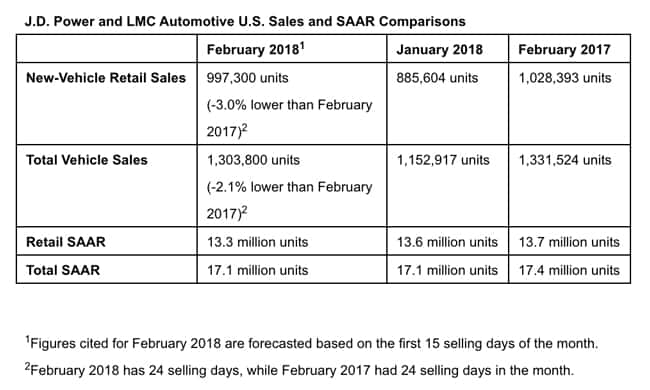
 February’s new vehicle retail sales pace in the U.S. is expected to decline from 2017 year-over-year levels, according to a forecast from J.D. Power and LMC Automotive.
The seasonally adjusted annualized rate (SAAR) for retail sales in February is expected to be 13.3 million units — a decline of 400,000 units from the same period in 2017. Actual retail sales for February are projected to reach 997,300 units, a 3.0 per cent YOY decrease.
“The industry is expected to deliver mixed results in February, with a decline in retail sales volume, higher transaction prices and the potential for the first year-over-year drop in incentive spending in more than four years,” said Thomas King, Senior Vice President of the Data and Analytics Division at J.D. Power.
Average incentive spending for new vehicles through the first three weeks of February is $3,840 — down $14 compared to the same period a year earlier. The downward slope in spending is “particularly notable given that incentives have risen consistently since 2013,” said King, adding that in December 2017, spending rose by over $400 from the previous year.
King says the decline is due to reduced spending in select segments of the industry, with an emphasis on trucks and SUVs offered by domestic manufacturers. “Incentives on domestic trucks and SUVs have fallen $450 through month-to-date.” However, incentives on non-domestic trucks and SUVs have actually increased by $482, and spending on all vehicles is up $80.
The average new vehicle retail transaction price to-date in February sits at $32,237 — a new record for the month. The previous high was $31,302 in 2017.