Canada’s automotive aftermarket continued to grow in 2025 as vehicles from the strong 2015-2019 sales years moved into peak repair and maintenance cycles — a trend with implications for dealership service departments and parts operations.
According to a survey conducted by DesRosiers Automotive Consultants (DAC) in collaboration with the Automotive Aftermarket Retailers of Ontario (AARO), the aging vehicle fleet is helping sustain demand for repair and maintenance work across the industry.
“With the high volume of vehicles sold from 2015-2019 now in their peak aftermarket years it is not surprising that the Canadian automotive (market) continued to see robust sales growth in 2025,” said Andrew King, Managing Partner at DAC, in a statement. “However, supply issues have persisted especially in regard to OEM parts, and the outlook for the aftermarket has a number of concerns moving forward.”

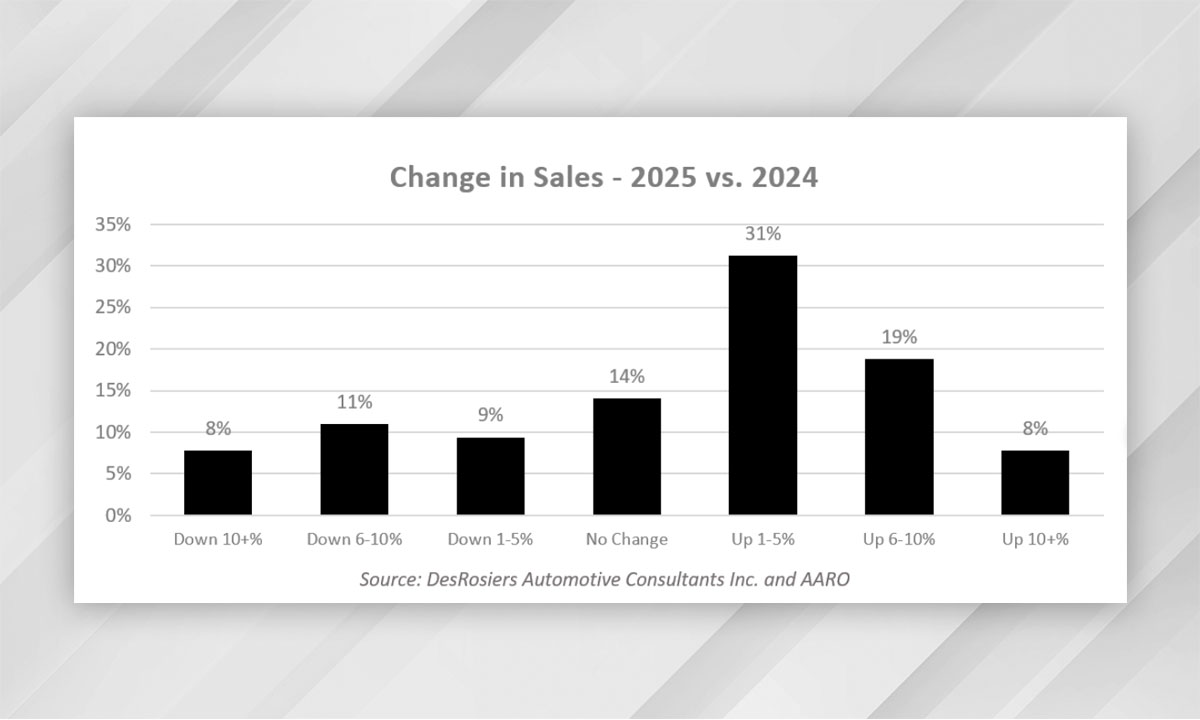
Survey responses indicate moderate growth for many aftermarket businesses. Thirty-one per cent of respondents reported sales in 2025 that were one to five per cent higher than in 2024. Another 19 per cent reported growth of six to 10 per cent, while eight per cent saw increases of 10 per cent or more. At the same time, 28 per cent reported declining sales and 14 per cent said sales were unchanged.
Expectations for 2026 remain largely positive. Forty-four per cent of respondents anticipate sales growth of one to five per cent, while 15 per cent expect no significant change. A smaller share expects stronger gains, though 26 per cent anticipate some level of decline.

Service demand also appears relatively stable. Oil changes, regular maintenance, diagnostics and preventative work were most often expected to remain consistent, while tire sales and tire service were the areas most likely to see business growth.
The survey also highlights the broader role dealerships play in the parts supply chain. Independent repair businesses frequently source OEM components through dealership parts departments, and 68 per cent of respondents reported experiencing supply issues when sourcing parts from new vehicle dealers. By comparison, 66 per cent reported no supply issues from jobbers.
Parts prices were also widely reported to be rising across both channels. From jobbers, 39 per cent of respondents reported price increases of up to five per cent, 40 per cent reported increases of six to 10 per cent, and 19 per cent cited increases of 10 per cent or more.
From new vehicle dealers, 39 per cent reported price increases of up to five per cent, 23 per cent cited increases of six to 10 per cent, and 34 per cent reported increases of 10 per cent or more.